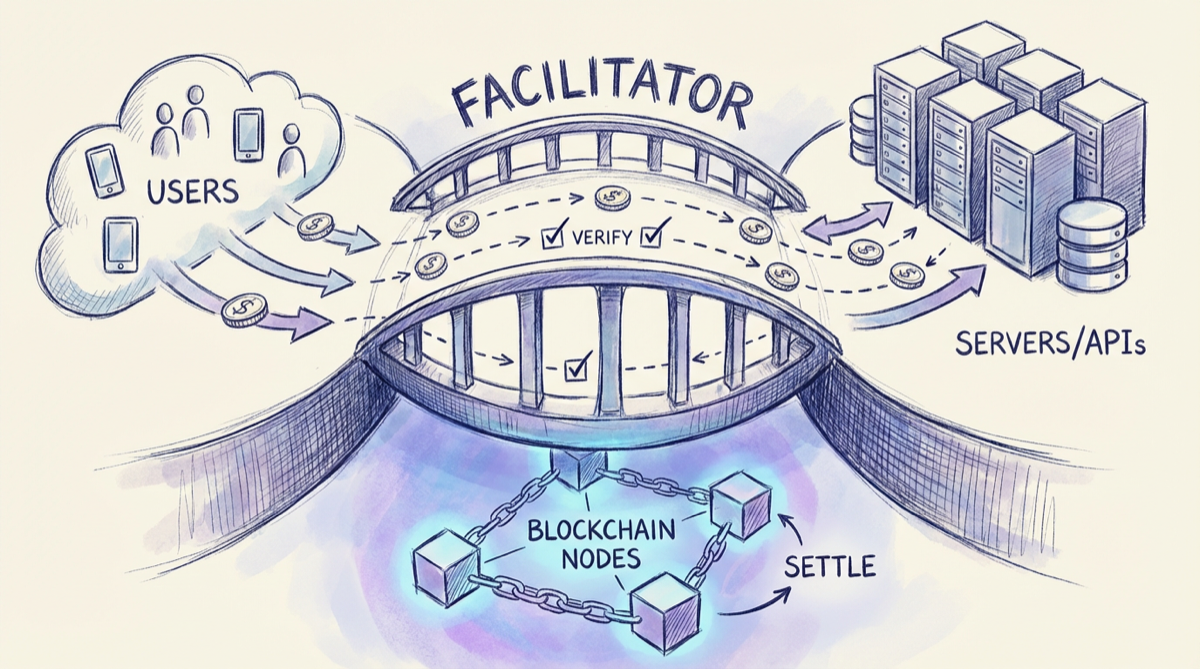
In the x402 protocol, facilitators are the invisible backbone that makes seamless crypto payments possible. They abstract away all blockchain complexity, enabling developers to accept payments without managing wallets, gas fees, or RPC connections.
What is a Facilitator?
A facilitator is a trusted third-party service that handles two critical operations in the x402 payment flow:
| Operation | Purpose | Latency |
|---|---|---|
| Verify | Cryptographic validation of payment signatures and balance checks | ~100ms |
| Settle | On-chain transaction submission and confirmation | ~2s on Base |
When a client sends a payment request with an X-PAYMENT header, your server doesn't need to interact with the blockchain directly. Instead, it forwards the payment payload to the facilitator, which handles all the heavy lifting.
The Verify-Then-Settle Pattern
Client → Server → Facilitator (/verify) → Server responds → Facilitator (/settle)
- Verify Phase: The facilitator validates the EIP-3009 signature, checks the payer's balance, and confirms the payment parameters match
- Settle Phase: After your server responds to the client, the facilitator executes the on-chain transfer asynchronously
This pattern optimizes for speed—users get instant responses without waiting for blockchain confirmation.
Why Facilitators Matter
1. Zero Blockchain Infrastructure
Without a facilitator, you'd need to:
- Run your own RPC nodes
- Manage hot wallets for gas payments
- Handle transaction signing and broadcasting
- Monitor for confirmations and failures
- Implement retry logic for failed transactions
Facilitators eliminate all of this complexity.
2. Compliance and Security
Production-grade facilitators like Coinbase's CDP include:
- KYT (Know Your Transaction) checks
- OFAC compliance screening
- Rate limiting and fraud detection
- Audit trails for all transactions
3. Multi-Network Support
A single facilitator can handle payments across multiple blockchains, letting you accept USDC on Base, Polygon, Solana, and more without deploying separate infrastructure for each.
Available Facilitators
Production Facilitators
1. Coinbase CDP Facilitator
The official Coinbase-hosted facilitator, recommended for production use.
| Property | Value |
|---|---|
| URL | https://x402.org/facilitator |
| Auth | CDP API Key required |
| Features | KYT/OFAC compliance, monitoring, SLA |
Supported Networks:
| Network | Type | Token |
|---|---|---|
| Base | Mainnet | USDC |
| Base Sepolia | Testnet | USDC |
| Solana | Mainnet | USDC |
| Solana Devnet | Testnet | USDC |
Setup:
import { facilitator } from "@coinbase/x402";
import { paymentMiddleware } from "x402-express";

// Requires CDP_API_KEY_ID and CDP_API_KEY_SECRET env vars
app.use(paymentMiddleware(walletAddress, routes, facilitator));
2. PayAI Facilitator
A Solana-first, multi-network facilitator with broad chain support.
| Property | Value |
|---|---|
| URL | https://facilitator.payai.network |
| Auth | API Key |
| Features | 12+ networks, Solana optimized |
Supported Networks:
| Network | Type | Token |
|---|---|---|
| Solana | Mainnet | USDC |
| Solana Devnet | Testnet | USDC |
| Base | Mainnet | USDC |
| Base Sepolia | Testnet | USDC |
| Polygon | Mainnet | USDC |
| Polygon Amoy | Testnet | USDC |
| Avalanche | Mainnet | USDC |
| Avalanche Fuji | Testnet | USDC |
| Sei | Mainnet | USDC |
| Sei Testnet | Testnet | USDC |
| IoTeX | Mainnet | USDC |
| Peaq | Mainnet | USDC |
| XLayer | Mainnet | USDC |
| XLayer Testnet | Testnet | USDC |
3. x402.rs Facilitator
An open-source, community-maintained facilitator.
| Property | Value |
|---|---|
| URL | https://facilitator.x402.rs |
| Auth | None (public) |
| Features | Open source, self-hostable |
Supported Networks:
- Base, Base Sepolia
- Solana, Solana Devnet
- Polygon
- Avalanche
- XDC
4. Stake Capital Facilitator
Enterprise-grade facilitator with over $2.35M processed.
Supported Networks:
- Avalanche
- Celo
- Solana
- Polygon
- Base
Test/Development Facilitator
x402.org Public Facilitator
For development and testing only—no API key required.
| Property | Value |
|---|---|
| URL | https://x402.org/facilitator |
| Auth | None |
| Limitations | Testnet only |
Supported Networks:
| Network | Type |
|---|---|
| Base Sepolia | Testnet |
| Solana Devnet | Testnet |
This is the default facilitator configured in the x402 middleware packages. Perfect for getting started quickly:
// No facilitator config needed for testing!
app.use(
  paymentMiddleware(walletAddress, {
    "GET /api/test": {
      price: "$0.001",
      network: "base-sepolia", // Uses x402.org by default
    },
  })
);
How Facilitators Work Under the Hood
Verify Endpoint
POST /verify
Content-Type: application/json

{
  "paymentPayload": { ... },
  "paymentRequirements": { ... }
}
The facilitator:
- Decodes the EIP-3009 or Solana authorization signature
- Verifies the signature is valid and from the claimed payer
- Checks the payer has sufficient balance
- Validates the nonce hasn't been used
- Confirms the payment amount and recipient match
Response:
{
  "isValid": true,
  "invalidReason": null,
  "payer": "0x..."
}
Settle Endpoint
POST /settle
Content-Type: application/json

{
  "paymentPayload": { ... },
  "paymentRequirements": { ... }
}
The facilitator:
- Constructs the on-chain transaction (e.g.,
transferWithAuthorizationfor EVM) - Submits to the blockchain
- Waits for confirmation
- Returns the transaction hash
Response:
{
  "success": true,
  "transaction": "0x...",
  "networkId": "84532"
}
Running Your Own Facilitator
For maximum control, you can run your own facilitator. This is useful for:
- Privacy: Keep payment data internal
- Custom Networks: Support chains not covered by public facilitators
- Cost Control: Avoid third-party fees
- Compliance: Meet specific regulatory requirements
The x402 GitHub repository includes example facilitator implementations you can customize.
Choosing the Right Facilitator
| Use Case | Recommended |
|---|---|
| Production (US/compliant) | Coinbase CDP |
| Multi-chain production | PayAI or Stake Capital |
| Development/testing | x402.org public |
| Self-hosted/privacy | x402.rs or custom |
Security Considerations
-
Trust Model: The facilitator sees all payment data. Choose one you trust or run your own.
-
Settlement Risk: Since content is served before settlement completes, there's a small risk window. See our developer's guide for mitigation strategies.
-
API Key Security: For production facilitators, protect your API keys. Never commit them to version control.
Related Articles
- x402 Developer's Guide - Build your first paid API
- ERC-3009: The Protocol Behind x402 Payments - Understanding transfer authorization
- Why x402 Doesn't Support USDT - Token compatibility explained
- Solana's Authorization Mechanism - How x402 works on Solana
Facilitators are what make x402 practical. By handling blockchain complexity behind a simple API, they let developers focus on building great products instead of managing infrastructure.